
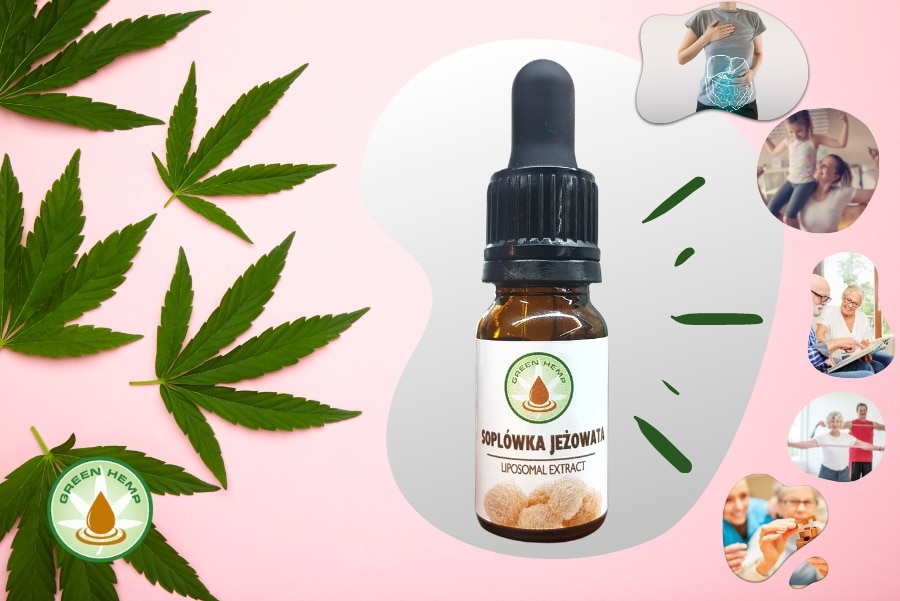
Hericium erinaceus has attracted increasing interest among researchers in recent years due to its rich phytochemical profile and wide range of biologically active compounds.This unique fungus, commonly known as Lion’s Mane mushroom or monkey’s head, is increasingly used in modern formulations such as liposomal extracts of Lion’s Mane, which are designed to improve the absorption and bioavailability of its active compounds.
Both the mycelium and fruiting bodies of Hericium erinaceus are a source of bioactive compounds whose activity has been demonstrated in in vitro, in vivo (animal), and clinical studies involving human subjects. Scientific reports suggest that regular consumption of this mushroom may support the body in the context of various health conditions, including neurodegenerative diseases such as Alzheimer’s disease, autoimmune disorders, and certain types of cancer.
It is important to note that preparations containing Hericium erinaceus are not registered as medicinal products. Therefore, products based on this mushroom are classified as dietary supplements or functional foods.
Hericium erinaceus is an edible mushroom found in North America, Europe, and Asia, typically growing in temperate forest zones. Its appearance is highly distinctive – it forms long, white, cascading spines resembling a beard or icicles.
Unlike most mushrooms, it does not develop a classic cap structure. Instead, the fruiting body takes on a hemispherical form, from which soft, elongated spines hang downward. These structures emerge from a compact, unbranched mass attached to wood.
The flesh of young specimens is white and firm, gradually turning yellowish-brown with age. As a saprotrophic organism, Hericium erinaceus grows primarily on dead or decaying wood. It can be found in forests during late summer, although it remains relatively rare in Poland.
Interestingly, its flavor is often described as reminiscent of seafood.
Lion’s Mane is a relatively slow-growing and demanding species. Its development is strongly influenced by environmental factors such as air circulation, light, temperature, humidity, and pH. The fungus is particularly sensitive to elevated levels of carbon dioxide (CO₂), which can lead to abnormal, coral-like deformation of the fruiting body.
The content of bioactive compounds in Hericium erinaceus depends significantly on the substrate on which it grows. As the fungus absorbs minerals from its environment, it may also accumulate undesirable substances such as heavy metals or radioactive elements if present in the growth medium. For this reason, the quality and origin of the raw material are of key importance.
Lion’s Mane has a long history of use in Asian countries such as China, Japan, India, and Korea, both as a culinary ingredient and a component of traditional medicine. Its role aligns with the concept of functional foods—products that provide nutritional value alongside potential health benefits.
Although its traditional use is well documented, scientific interest in its therapeutic properties began to develop more intensively in the 1990s, with a significant portion of early research conducted by Chinese scientists.
At present, the available clinical data are still insufficient to classify Hericium erinaceus preparations as medicinal therapies. However, results from in vitro and animal studies are highly promising.
An important advantage of this mushroom is its favorable safety profile. The low incidence of side effects suggests that Lion’s Mane may be considered a safe form of dietary support and a complementary element to conventional approaches. Additionally, it can be easily incorporated into the diet as a functional food ingredient.
Current research focuses particularly on the neuroprotective potential of compounds found in Hericium erinaceus. Studies indicate that it may support the nervous system, especially in the context of neurodegenerative conditions and nerve damage.
The mushroom has also demonstrated antioxidant and anti-inflammatory properties. These effects are associated with its ability to influence molecular processes, including the regulation of cytokine expression and transcription factors.
According to available data, compounds present in Lion’s Mane – including those delivered in advanced forms such as liposomal extracts – may contribute to reducing oxidative stress and modulating inflammatory responses in the body.
According to available data, compounds present in Lion’s Mane – including those delivered in advanced forms such as liposomal extracts – may contribute to reducing oxidative stress and modulating inflammatory responses in the body.
Chemical analyses indicate that 100 grams of dried Hericium erinaceus fruiting body contains approximately:
– 22.3 g of protein
– 3.5 g of fat
– 64.8 g of carbohydrates
– 4.3 g of water
The mushroom provides 16 amino acids, including seven essential ones.
Its characteristic taste and aroma result from a complex combination of volatile compounds, including essential oils and nitrogen-containing derivatives.
Hericium erinaceus contains a wide spectrum of biologically active substances, including enzymes (such as amylase and laccase), phenolic compounds (e.g., ferulic acid), lectins, and numerous polysaccharides.
Among these, beta-glucans, alpha-glucans, and glucan-protein complexes are considered the most significant in terms of biological activity.
Beta-glucans are known for their ability to lower LDL cholesterol levels, which may contribute to reducing the risk of cardiovascular disease. Due to their immune-modulating properties, mushrooms rich in beta-glucans—including Lion’s Mane—are the subject of intensive scientific research.
The neuroprotective properties of Hericium erinaceus have been demonstrated in both in vitro and animal studies.
In experimental models of Alzheimer’s disease, supplementation with Lion’s Mane has been shown to improve spatial memory and visual recognition.
Clinical studies have also investigated its effects in individuals experiencing depressive symptoms. In one study, peri-menopausal women who consumed 2 grams of powdered fruiting body daily for four weeks reported a reduction in symptoms of depression and anxiety.
Another clinical trial involving patients with mild cognitive impairment demonstrated that daily intake of 1 gram of powdered mushroom three times a day for 16 weeks led to measurable improvements in cognitive function.
Importantly, no significant adverse effects were observed in the participants.
In practice, Lion’s Mane is often combined with other neuro-supportive compounds, creating more comprehensive formulations aimed at supporting cognitive function and mental clarity. Liposomal Neuro Herb
If you want to better understand how cognitive decline develops and what mechanisms influence focus and mental performance, it is worth exploring this topic in more detail. How to restore focus and energy? The regenerative process.
In vitro studies have demonstrated that extracts of Hericium erinaceus can inhibit the growth of Helicobacter pylori, a bacterium associated with chronic gastritis, peptic ulcer disease, and gastric cancer.
Animal studies further suggest that freeze-dried Lion’s Mane may help protect the gastric mucosa, reducing damage and swelling, and providing cytoprotective effects against ethanol-induced ulcers.
A clinical study conducted in 1985 involving 50 patients with chronic atrophic gastritis showed that a three-month supplementation with Hericium erinaceus extract led to a reduction in inflammatory markers and epigastric pain.
In vivo studies conducted on animal models indicate that polysaccharides found in Hericium erinaceus may exert anti-ischemic effects.
Supplementation with Lion’s Mane has been associated with improvements in lipid profiles, including reductions in triglycerides, total cholesterol, LDL cholesterol, and phospholipids.
These findings suggest a potential hypolipidemic effect of the mushroom, which may support cardiovascular health.
Under laboratory conditions, extracts from Hericium erinaceus have demonstrated activity against various human pathogenic bacteria, including antibiotic-resistant strains.
Among the most notable findings is the ability of compounds present in Lion’s Mane to inhibit the growth of methicillin-resistant Staphylococcus aureus (MRSA).
Additionally, inhibitory effects against Helicobacter pylori have been observed, further supporting its potential role in maintaining gastrointestinal health.
Despite the growing body of research on the therapeutic potential of Hericium erinaceus, available clinical studies report a very low incidence of adverse effects.
In one study, participants consuming 1 gram of powdered mushroom three times daily for 16 weeks reported mild gastrointestinal symptoms, such as stomach discomfort and diarrhea.
Other clinical trials have not identified significant side effects associated with the use of Lion’s Mane.
Content and elaboration: Sara Janowska, M.Sc. in pharmacy
Literature:
Jiang, S., Wang, S., Sun, Y., & Zhang, Q. (2014). Medicinal properties of Hericium erinaceus and its potential to formulate novel mushroom-based pharmaceuticals. Applied microbiology and biotechnology, 98(18), 7661-7670.
Friedman, M. (2015). Chemistry, nutrition, and health-promoting properties of Hericium erinaceus (Lion’s Mane) mushroom fruiting bodies and mycelia and their bioactive compounds. Journal of Agricultural and Food Chemistry, 63(32), 7108-7123.
Liu JH, Li L, Shang XD, Zhang JL, Tan Q. Anti-Helicobacter pylori activity of bioactive components isolated from Hericium erinaceus. J Ethnopharmacol. 2016;183:54-58.26364939
Mori K, Inatomi S, Ouchi K, Azumi Y, Tuchida T. Improving effects of the mushroom Yamabushitake (Hericium erinaceus) on mild cognitive impairment: a double-blind placebo-controlled clinical trial. Phytother Res
Nagano M, Shimizu K, Kondo R, et al. Reduction of depression and anxiety by 4 weeks Hericium erinaceus intake. Biomed Res. 2010;31(4):231-237.20834180
https://www.drugs.com/npp/lion-s-mane-mushroom.html#20834180